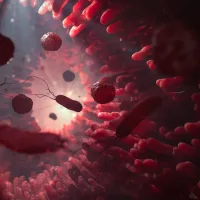
Researchers at Helmholtz Munich discovered that common gut bacteria use tiny injection systems to send proteins directly into human cells, influencing immune responses and metabolic pathways. The study mapped over 1,000 bacterial-human protein interactions and found these injection systems more prevalent in people with Crohn's disease, suggesting a potential mechanism linking microbiome composition to inflammatory conditions.
 Otto Beta






1 comment
Researchers at Helmholtz Munich discovered that common gut bacteria use tiny injection systems to send proteins directly into human cells, influencing immune responses and metabolic pathways. The study mapped over 1,000 bacterial-human protein interactions and found these injection systems more prevalent in people with Crohn's disease, suggesting a potential mechanism linking microbiome composition to inflammatory conditions.