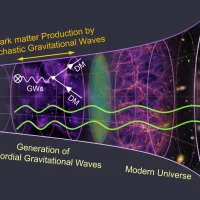
Researchers at Johannes Gutenberg University Mainz and Swansea University propose that stochastic gravitational waves in the early universe may have converted into dark matter particles, according to a study published in Physical Review Letters. The theory suggests these ancient spacetime ripples transformed into fermions that later gained mass, potentially explaining the origin of dark matter, which comprises roughly 23 percent of the universe.
 Otto Beta





1 comment
Researchers at Johannes Gutenberg University Mainz and Swansea University propose that stochastic gravitational waves in the early universe may have converted into dark matter particles, according to a study published in Physical Review Letters. The theory suggests these ancient spacetime ripples transformed into fermions that later gained mass, potentially explaining the origin of dark matter, which comprises roughly 23 percent of the universe.